
The Gift of the Nile
The Greek historian Herodotus called Egypt the gift of the Nile in the 5th century BC. The description holds. The Nile runs 6,650 kilometres from the East African highlands to the Mediterranean. It is the longest river in the world, and for most of its journey, it cuts through absolute desert. Without this water, there is no Egypt. The river deposited the silt that made agriculture possible, creating the surplus that built the cities. Those cities produced the administration, the art, and the engineering that allowed a single civilisation to dominate the Mediterranean for three thousand years.
Cairo
The city holds roughly 20 million people in its metropolitan area—the largest in Africa and the Arab world. It sits where the Nile Delta begins, functioning at a volume and intensity that requires mental recalibration. The traffic runs on a logic of its own, where honking is a primary form of communication. A single walk between the Islamic Quarter and the modern downtown covers 1,400 years of continuous history. Further north, Alexandria sits on the Mediterranean coast. Founded by Alexander the Great in 331 BC, it was the capital of Ptolemaic Egypt and held the ancient world’s largest library. Today, it retains a cooler, more European character, facing the sea rather than the sand.
Ancient Egypt
To the south, Luxor sits on the site of ancient Thebes, the capital of the New Kingdom pharaohs. The Valley of the Kings lies across the river on the west bank—63 tombs cut into limestone cliffs, including Tutankhamun’s, discovered intact in 1922. Further south, Abu Simbel stands in the Nubian desert near the Sudanese border. Two temples were carved directly into a sandstone cliff by Ramesses II in the 13th century BC. The 20th-century engineering required to cut these temples into blocks and move them 65 metres uphill to save them from flooding remains one of the great feats of modern archaeology.
Hotels.com: Save up to 25% on mobile exclusive offers!


Episode
In-Depth: Egypt
The Egypt episode of the NAO Podcast covers the timeline from unification around 3100 BC to Alexander the Great’s conquest. It moves through the geography, the history, the astronomy, and the cultural details that make ancient Egypt specific rather than abstract.
Pyramids
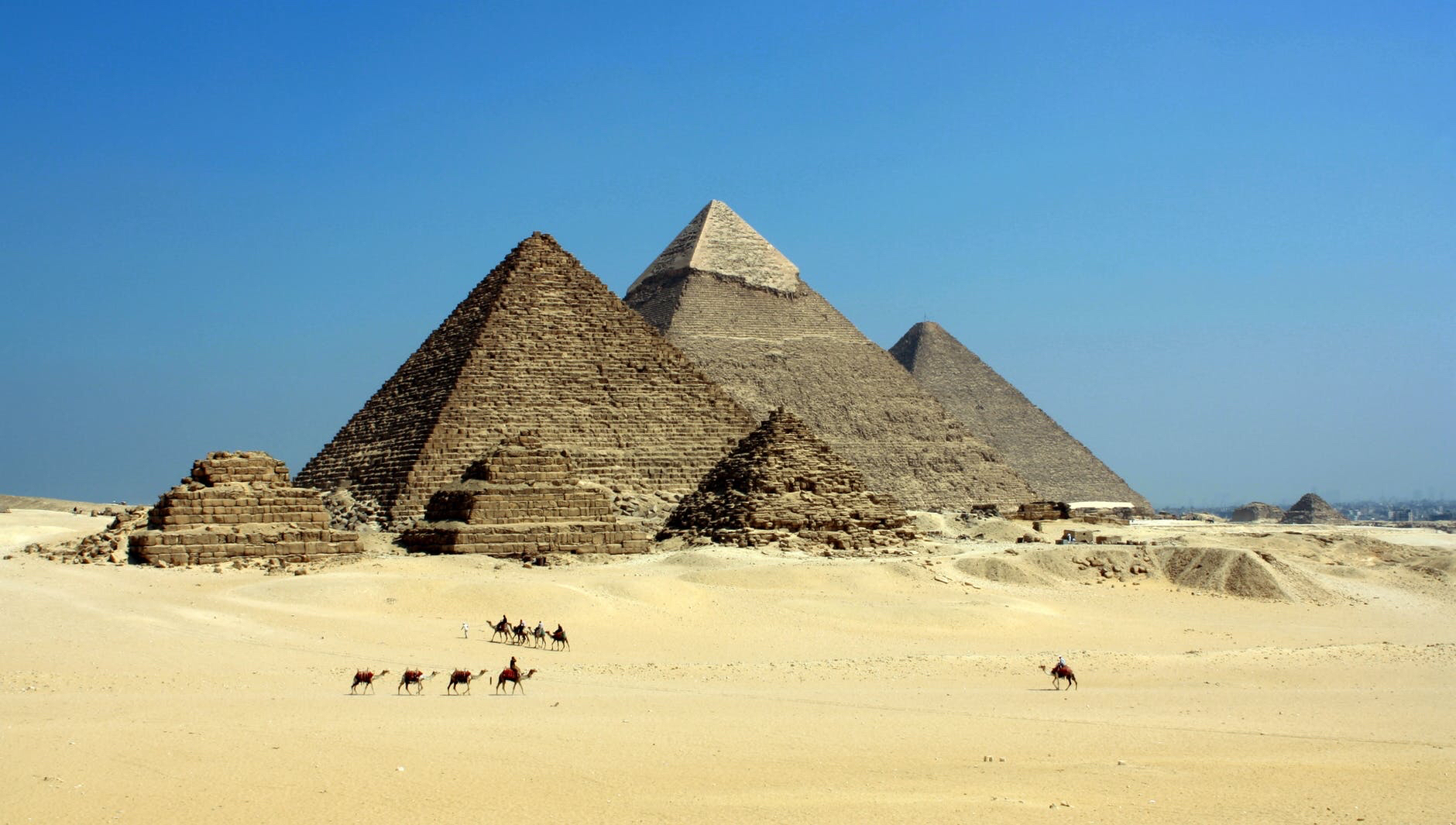
The Great Pyramid of Giza anchors the episode. Built around 2560 BC for the Pharaoh Khufu, it stood as the tallest structure on Earth for 3,800 years. It was constructed from approximately 2.5 million limestone and granite blocks weighing between 2.5 and 80 tonnes each. The outer casing stones, now mostly stripped away, were polished white limestone that made the structure visible for miles. The pyramid aligns precisely to the four cardinal points with an accuracy of 0.05 degrees. How workers achieved this without modern instruments remains unresolved; the episode sits with the mystery rather than inventing an answer.
Precession
The episode explores the 25,920-year precession cycle—the slow wobble of Earth’s axis that shifts the celestial north pole over millennia. Ancient Egyptian priests tracked this cycle and built it into their cosmological frameworks. Beyond astronomy, we cover the Egyptian relationship with cats—revered as divine, adorned with jewellery, and mummified for the afterlife. The domestic cat as a household companion spread from Egypt through the ancient world along trade routes. This cultural export may be the most enduring thing ancient Egypt ever produced.
Food
Cooking: Egyptian Koshary
Francesco prepares koshari in the NAO kitchen—Egypt’s national dish and a masterclass in culinary intersectionality.
Koshari combines rice, brown lentils, chickpeas, and macaroni, topped with a sharp tomato sauce spiked with cumin and chilli, and finished with crispy fried onions. It emerged in 19th-century Cairo from the collision of Egyptian, Indian, Italian, and British influences. It is filling, cheap, and fast—the fuel of a city of 20 million. The spread also includes falafel made from fava beans (the Egyptian original), baba ghanoush, and pita bread. The flavour profile is earthy and warm, built on cumin, coriander, and turmeric.
Interview
My Cairo and Pyramid Experience
Richard Huitema visited Cairo and Giza as part of a filming trip. He describes the pyramids as something photographs cannot prepare you for—larger up close than any scale reference suggests and disorienting in their mass. During the trip, a colleague ignored warnings about the local camel rides—a documented hustle where handlers help tourists up, then demand extra cash to let the camel back down. The camel stayed up until the demands were met. Richard watched from a safe distance; the pyramids remained impressive, even if the local negotiations did not.
His full story — including the Royal Netherlands Navy deployments to Somalia, Yugoslavia, Bosnia, Libya, and Afghanistan — is on his interview page.
For more on Africa — covered in full on NAO.

