


Rouen to Mont Saint Michel
Normandy occupies the rugged northwestern coast of France. It stretches from the Seine valley in the east to the Cotentin Peninsula in the west. This region covers 30,000 square kilometres and holds around 3.3 million people. It is one of the most historically significant landscapes in Europe. Viking settlements produced the Norman dynasty here. In 1066, William the Conqueror departed from this coastline for England. Centuries later, the Allied landings of June 1944 took place on these same beaches, changing the direction of the Second World War forever.
The landscape moves between two distinct registers: the lush inland and the jagged coast. The interior is a world of half-timbered villages, apple orchards, and dairy farms. The Pays d’Auge produces France’s most iconic cheeses: Camembert, Livarot, and Pont-l’Évêque. It also produces the finest cider and Calvados in the country. The coastal edge features dramatic white chalk cliffs from Étretat eastward. Claude Monet painted these cliffs repeatedly in the 1880s, obsessed with the shifting light. The Arsène Lupin stories also use them as a setting for hidden passages and buried treasure.


Rouen: The Viking Capital
Rouen is the regional capital and a city of deep character. The old quarter is a maze of half-timbered houses that reflect the Germanic influence of Norse settlers. These Vikings navigated the Seine in the 9th and 10th centuries, leaving an architectural mark that feels distinct from most French cities further south. The Cathédrale Notre-Dame de Rouen dominates the city centre. Monet immortalized it in a series of 30 canvases, each capturing the stone as it changed color under different light conditions. Nearby, the Gros Horloge—a 14th-century astronomical clock—sits on a Renaissance arch. It still tracks the day of the week, the lunar cycle, and the solar year simultaneously.
The history here is heavy. Joan of Arc was burned at the stake in Rouen in 1431 at just 19 years old. A modern church, built in the 1970s, now marks the exact site of her execution pyre. The Norman kitchen is equally intense. It leans on heavy cream, butter, and seafood. The signature dish is Duck à la rouennaise—pressed duck in a rich sauce made from the bird’s own liver. The Saturday market at Place du Vieux-Marché is packed with producers from across the Pays d’Auge selling cheese, cider, and andouille sausage. The city rewards a slow day on foot.
Honfleur: The Cradle of Impressionism
Honfleur sits on the southern bank of the Seine estuary. It is a working port town with a 17th-century harbour that drew the world’s greatest painters. The relationship between Honfleur’s light and the development of Impressionism is direct. It was here that Eugène Boudin taught a young Claude Monet to paint outdoors in the 1850s. The slate-fronted houses and the Lieutenance building at the quayside remain largely unchanged from the paintings that documented them 150 years ago.


Travel vLog
Mont-Saint-Michel: The Island Between Worlds
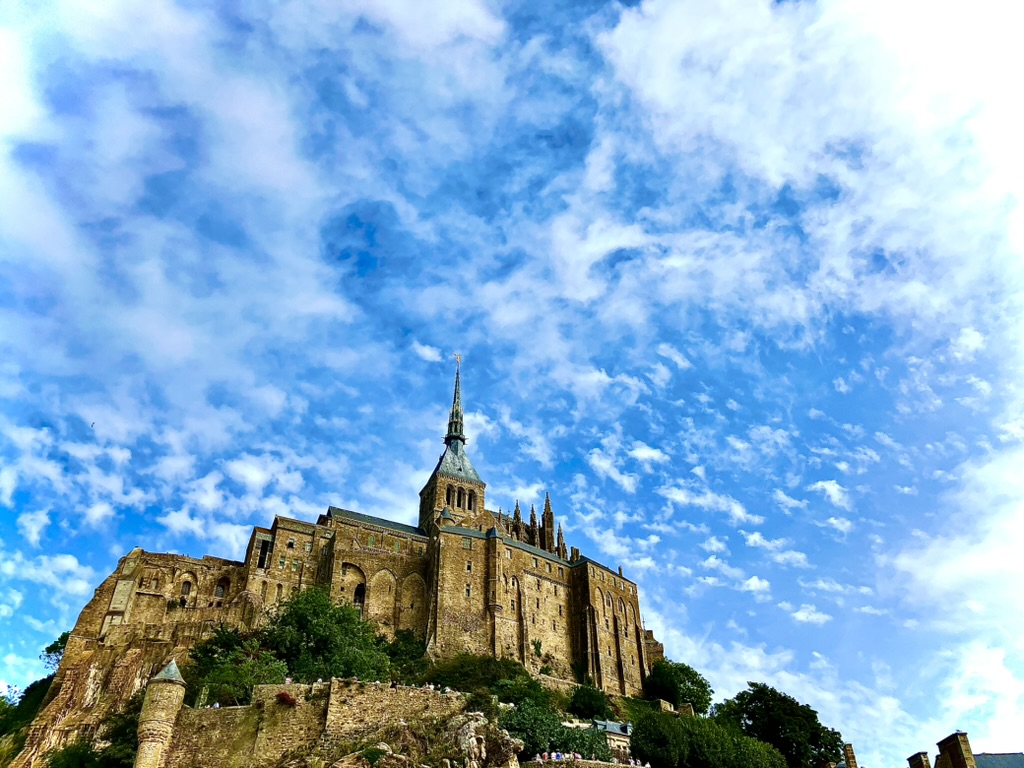
Mont-Saint-Michel rises 92 metres from a tidal island in the bay between Normandy and Brittany. Benedictine monks founded the abbey at its summit in 708 AD. The medieval village clings to the rock below—a fortress of ramparts, steep streets, and a fortified gate. The site has functioned continuously for over 1,300 years as a monastery, a pilgrimage destination, and even a prison during the French Revolution. It is now one of the most visited locations in France, drawing 3 million people annually.
The abbey church at the summit dates from the 11th century. The cloister, added in the 13th century, remains one of the finest examples of Norman Gothic architecture in existence. Below the abbey, the Grande Rue runs the length of the island. It is narrow, steep, and lined with restaurants. Most visitors stay on the main street, but the upper rampart walk is considerably quieter. It offers a full view across the bay in both directions.
The tidal range in the bay reaches 14 metres—one of the largest in Europe. At low tide, the island connects to the mainland across vast sand flats. At high tide, it sits fully surrounded by water. To reach it, visitors park 2.5 kilometres away. A free shuttle bus is available, but the 30-minute walk is the better choice. It delivers progressively more dramatic views as the abbey looms larger against the sky.
Episode
Holland to France: A Journey Through NORMANDY
The NAO team drove from Holland to Normandy as a family road trip. We covered Rouen, the D-Day coastline, and Mont-Saint-Michel. The route runs south from the Channel and moves steadily westward, covering around 600 kilometres from Amsterdam.
Our Rouen episode explores the Viking foundations of the city and the Gros Horloge. We also dive into the street food—crepes loaded with bacon, eggs, and fries—and fresh mussels pulled straight from the coast. The Mont-Saint-Michel segment covers the full 2.5-kilometre approach and features drone footage of the abbey rising from the bay. The aerial shots show the island’s scale clearly. The village is wrapped tightly around the rock. The island is crowded, but it is extraordinary. Both things are true, and neither cancels the other.
Name: Normandy
Location: Northwestern France
Character: Viking History / Impressionist Light / Gothic Fortresses
Related Content
Your new flight deals have landed