
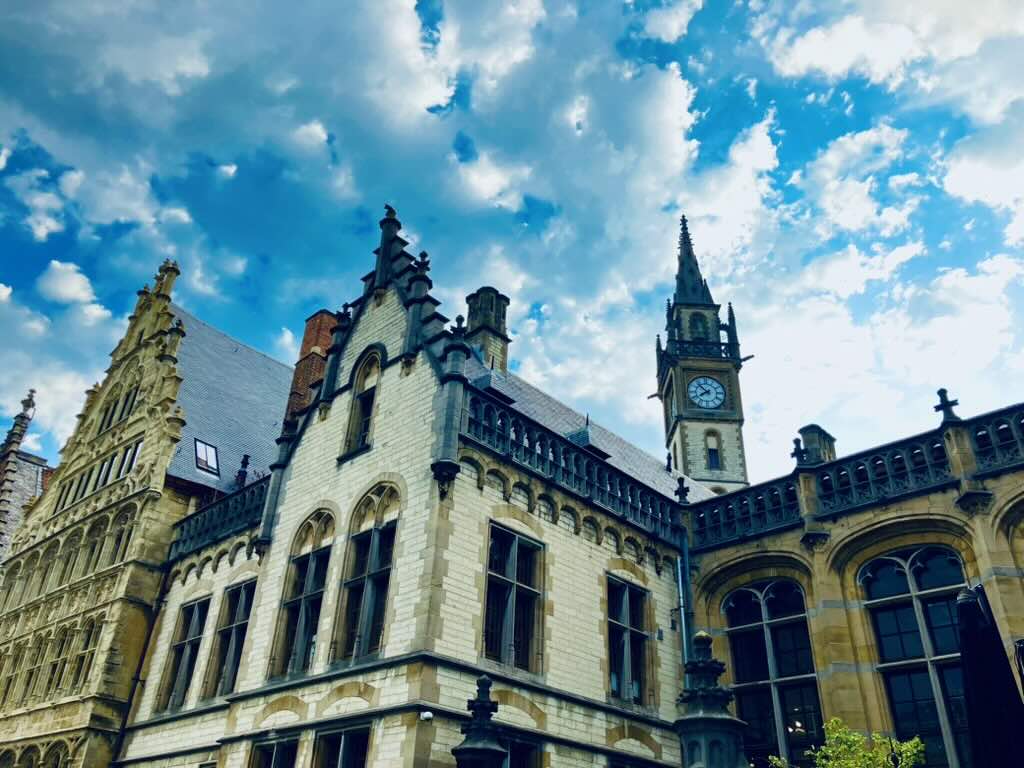
Ghent: Belgium’s Hidden Gem of Character
Ghent sits at the confluence of the Leie and Scheldt rivers in the heart of Flanders. It is a city that refuses to be a museum. With a population of 260,000, it carries one of the densest concentrations of medieval architecture in Northern Europe. Saint Bavo’s Abbey was founded here in 630 AD. By the 13th century, Ghent was the second-largest city north of the Alps, eclipsed only by Paris. The textile trade fueled this explosion of wealth. Today, the guild houses along the Graslei waterfront stand as stone monuments to the wool and linen that built the city’s foundations.
The City: Castles and Altarpieces
The Gravensteen is the city’s most recognizable landmark. The Count of Flanders built this military stronghold in 1180. It sits on an island in the Leie—massive stone walls, a dark moat, and a keep that has barely changed since the 12th century. Nearby, inside Saint Bavo’s Cathedral, sits the Ghent Altarpiece. Completed by Jan van Eyck in 1432, it remains one of the most studied and stolen paintings in human history. The work survived the Iconoclasm, Napoleon, and two world wars. It still rests in the cathedral where it was first installed nearly 600 years ago.
Ghent University, founded in 1817, injects a restless energy into the ancient streets. With 44,000 students, the population keeps the city young. It supports a cultural infrastructure of music venues, independent bookshops, and small galleries that larger tourist cities rarely sustain. The Patershol neighborhood reflects this perfectly. It is a cluster of narrow medieval lanes north of the Gravensteen. The buildings are 17th century, but the kitchens are current. It holds some of the best restaurants in Belgium alongside hidden workshops and independent arts spaces.

Food and Beer: Beyond the Tourist Trail
The food culture in Ghent runs deeper than frites and waffles. Waterzooi is the city’s signature dish—a rich, cream-based stew traditionally made with fish from the Leie. Today, chicken is the standard. You also find stoofvlees at most traditional tables—beef braised slowly in dark Belgian beer until it falls apart. Ghent is also a pioneer. In 2009, it introduced “Veggie Thursday.” Every week, restaurants across the city offer meat-free menus. The movement started here and has since spread across Belgium.
The beer culture operates at a different scale. Belgium produces over 1,500 varieties. Ghent’s pubs run the full range—Trappist ales, funky lambics, and strong abbey beers that reach 10% ABV with deceptive ease. In the evening, the Graslei and Korenlei quays fill with people. The medieval facades reflect in the dark water of the Leie. Ghent is an unhurried city. Sitting on a canal terrace with a well-made glass of Tripel is not a tourist activity; it is how the city breathes.
Street Art: The Evolving Alley
The street art scene is concentrated in the Werregarenstraat. This narrow alley was designated a legal graffiti zone in the 1990s. It has functioned as a continuously evolving outdoor gallery ever since. Artists paint over previous work daily. Nothing lasts. The alley documents the immediate moment rather than history. The NAO Street Art Documentary covers the wider movement across Europe—Ghent is a vital chapter in that story.
Episode
Underrated Gem: When did Ghent Become such a Cool City ?
NAO arrived in Ghent as part of a broader European road trip. The city wasn’t the main destination—it became one. We started at the Gravensteen. The approach from the water gives the best read on its scale. It is a 12th-century military fortress sitting in the middle of a working city, surrounded by tram lines and bike traffic. It hasn’t been softened for visitors. The interior still holds a torture museum, and the rooftop provides a 360-degree view of the medieval center.
We moved through the Patershol lanes, a neighborhood that feels entirely removed from the tourist circuit. Lunch was waterzooi served in a deep bowl with crusty bread. We spent the afternoon in Werregarenstraat, 50 meters of floor-to-ceiling layered graffiti. Nearby, the Vrijdagmarkt square continues to serve as a public gathering point, just as it has since the Middle Ages.
We ended the day at the Graslei waterfront. The guild houses, dating from the 12th to the 17th century, line the canal in an unbroken row. We grabbed cuberdon cones—Ghent sugar cones filled with raspberry gel—from a local vendor. Ghent is the kind of city that rewards the decision to stay an extra day. Most people do.
Name: Ghent (Gent)
Location: Flanders, Belgium, Europe
Character: Medieval Fortress / Student Spirit / Culinary Grit
Your new flight deals have landed


