
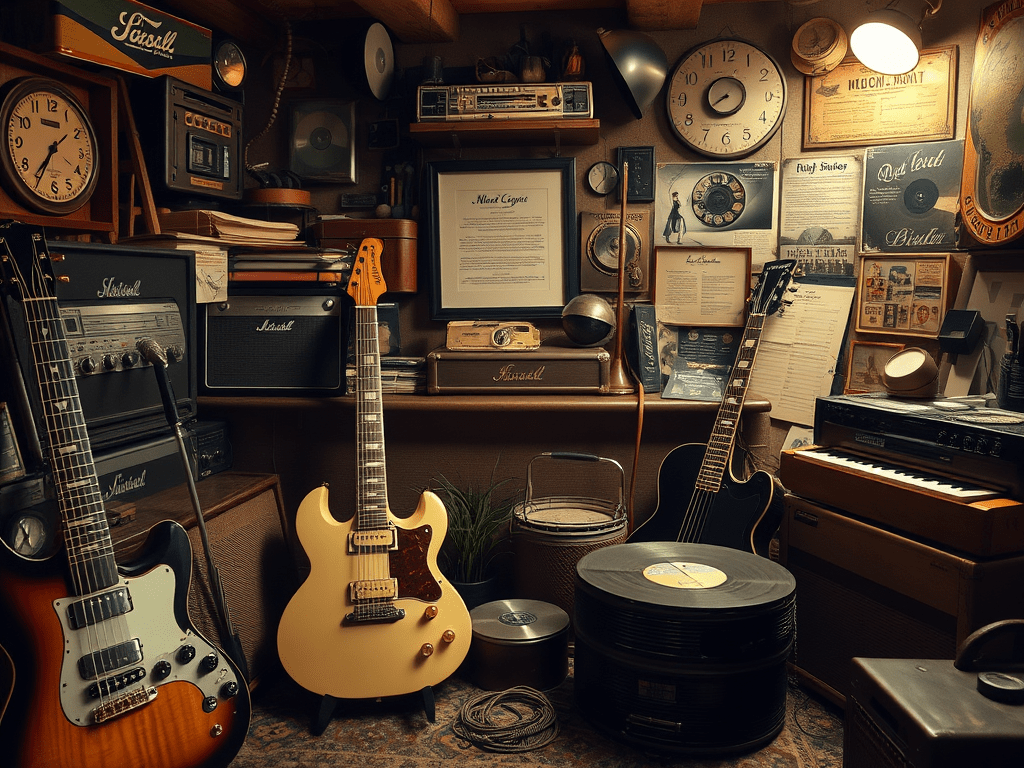
A Bridge of Sound:
The world is a loud place, but most of it is noise. At Name And Occupation, we look for the signal. We look for the songs that stayed when the people left. This is a record of the things that were made well and the men and women who made them. It is a long journey from the broken glass of a Bronx summer to the clean, cold light of a London studio. It is a history of the “extraordinary ordinary”—the work of the soul when the soul has something to say.
We have built a digital sanctuary for these sounds. We have dug deep into the earth of the global time capsule to find the rhythms that did not break. From the fast, hard chords of a Manhattan basement to the ancient, mist-heavy pipes of the high country, this is the story of how we lived and how we sang about it. It is honest and it is true. It is the music that built the cities and the music that survived them. This is the archive. Read it, and remember the noise that made us.
THE DELTA ECHO: PRESERVING THE FOUNDATIONAL HISTORY OF THE BLUES
MISSISSIPPI BLUES – Delta Blues History & Legends
To understand these modern explosions, we must look further back to the foundations of the American soundscape. The History of the Blues is the history of resilience. Born in the Mississippi Delta, the Blues carried the weight of the African American experience through field hollers and spirituals. It is a music of deep emotion and structural simplicity, yet its influence is infinite. When the Great Migration pulled southern musicians toward the north, the acoustic blues became electrified in cities like Chicago, setting the stage for everything from rock and roll to soul. It is the root system of nearly every contemporary genre we document today.
The Blues represents the “name” of suffering and the “occupation” of endurance. The early bluesmen and women were traveling historians, carrying stories of hardship, love, and the search for a better life from one plantation to the next. The 12-bar structure provided a predictable framework that allowed for infinite individual expression. This duality—rigid structure paired with wild, improvisational emotion—is what makes the Blues so enduring. As we archive the sounds of a slide guitar or a soulful harmonica, we are connecting with a lineage of storytellers who used music to survive the unsurvivable.
IMPROVISATION AND LIBERATION: THE CHRONICLES OF AMERICAN JAZZ
NEW ORLEANS JAZZ – Birthplace of Jazz Music History
Parallel to the Blues, Jazz emerged from New Orleans as a sophisticated tapestry of African, Caribbean, and European traditions. Known as America’s classical music, Jazz elevated improvisation to a high art form. It evolved through the swinging big bands of the thirties to the lightning-fast complexities of Bebop in the forties. Jazz teaches us that a time capsule is not a static box; it is a breathing, changing entity that thrives on the spontaneity of the moment. It is the sound of freedom and the constant pursuit of the new.
In the jazz world, your “name” was your reputation, and your “occupation” was your ability to “cut” on the bandstand. The genre thrived in the vibrant nightlife of cities like New Orleans, Chicago, and New York. It was a music that defied segregation, bringing people together in the shared pursuit of a “blue note” or a perfectly timed syncopation. Jazz isn’t just about the notes on the page; it’s about the space between them. It is the art of listening as much as it is the art of playing. By documenting jazz, we are archiving the very essence of human conversation translated into brass and woodwind.
THE PULSE OF THE STREETS: THE REVOLUTIONARY HISTORY OF NYC HIP HOP
The rhythmic heartbeat of a city or the ancestral hum of a distant coastline is more than just entertainment; it is the living record of who we were and who we are becoming. We view music not as a commodity but as a vital component of the human time capsule—a sonic signature that defines an era just as clearly as a photograph or a handwritten journal. From the grit of a New York subway station to the hallowed echo of a London studio, these movements represent the extraordinary ordinary of our collective global heritage.
The evolution of sound often begins in the most overlooked corners of the world. In the early 1970s, the South Bronx was a landscape of structural neglect and economic hardship, yet it birthed the most influential cultural movement of the modern age. New York City Hip Hop did not start on the radio; it started in community rooms and parks where innovators realized that the “break” in a funk record was where the soul of the party lived. By isolating those seconds of percussion, they created a foundation for MCs to speak their truth. This was a grassroots preservation of rhythm that turned the concrete jungle into a classroom, proving that out of decay comes the most vibrant forms of life.
As the movement matured, it branched into four distinct pillars: DJing, MCing, Breaking, and Graffiti. Each pillar was an occupation in its own right, a specialized craft that required dedication and a deep understanding of urban identity. The 1980s saw this local Bronx phenomenon transform into a global powerhouse, influencing fashion, language, and politics. When we look back at the early footage of block parties and subway cars covered in vibrant tags, we aren’t just seeing art; we are seeing a community asserting its existence against a backdrop that tried to ignore them. It is the ultimate survival story told through a rhythmic pulse that now echoes in every corner of the planet.
ARCHITECTS OF HARMONY: THE LONG LEGACY OF CLASSICAL MUSIC
ALBERT FRANTZ – From Philly to Bösendorfer Concert Artist in Vienna
Further back in our archive lies the expansive History of Classical Music. This is a journey through centuries of European thought, moving from the mathematical perfection of the Baroque period to the dramatic, sweeping emotions of the Romantic era. Classical music provides the structural blueprints for how we understand melody and harmony. Whether it is the religious devotion found in a Bach cantata or the revolutionary fire of a Beethoven symphony, this genre represents the peak of formal human composition and the enduring power of the written score.
Classical music serves as the most meticulously preserved section of our global time capsule. Because it was written down with such precision, we can hear exactly what a composer intended hundreds of years ago. Yet, every conductor and every orchestra brings a new “occupation” to the piece, reinterpreting the old for a modern audience. It reminds us that tradition is not about worshiping ashes, but about keeping a fire burning. From the chamber rooms of royalty to the public concert halls of today, classical music remains a testament to the human desire for order, beauty, and transcendence.
ANCESTRAL MISTS: THE ENDURING SPIRIT OF CELTIC MUSIC HISTORY
NATHAN BISHOP MACDONALD – Cape Breton Singer-Songwriter & Celtic Music Deep Dive
In the mist-covered landscapes of Ireland, Scotland, and Wales, the History of Celtic Music offers a different kind of preservation. This is an oral tradition, passed down through generations of bards and village fiddlers. Celtic music is a haunting reflection of the land itself—rugged, beautiful, and deeply connected to ancestral memory. Its survival through centuries of displacement and cultural suppression is a testament to the strength of community. When we hear the drone of a pipe or the bright snap of a fiddle, we are hearing a direct link to a past that refuses to be forgotten.
This music was the “occupation” of the common person. It wasn’t found in books but in the memory of the elders. It accompanied every part of life—weddings, wakes, harvests, and battles. As Celtic people migrated across the globe, they took their songs with them, planting the seeds for what would eventually become bluegrass and country music in the Americas. At NameAndOccupation, we recognize that these melodies are the “name” of a people who, despite having their land taken, kept their identity through the air they breathed into their instruments.
THE GLOBAL MOSAIC: TRACKING INTERNATIONAL MUSIC THROUGH TIME
The Many Lives of Author/Musicain Marc Cinanni
As we expand our lens to International Music History, we see that the world is a mosaic of overlapping sounds. From the highlife rhythms of West Africa to the intricate ragas of India, music serves as the ultimate universal language. In the modern era, these boundaries are blurring. We are witnessing a global exchange where traditional folk instruments meet electronic textures. Our mission at NameAndOccupation is to capture these intersections, ensuring that as cultures blend, the original spirit of each unique tradition is respected and archived for those who will follow us.
International music history is the study of how humanity interacts across borders. It is the sound of the Silk Road, the Trans-Atlantic trade, and the digital clouds of today. Every instrument—whether it is a sitar, a kora, or a steel drum—carries the history of its people. By treating the world as a singular, diverse archive, we can see how the human experience is unified by the need to create rhythm. We don’t just see different cultures; we see the different “occupations” humans have invented to explain the mystery of existence through sound.
FROM CANYONS TO THE STRIP: THE SONIC EVOLUTION OF LOS ANGELES
HOW LOS ANGELES CHANGED MUSIC FOREVER – From Laurel Canyon to Hip Hop Revolution
Across the American continent, Los Angeles Music History tells a story of sunshine and shadow. LA was the birthplace of the surf sound that defined the sixties, but it was also the home of the gritty Sunset Strip where heavy metal and glam rock took hold. From the folk-rock harmonies of Laurel Canyon to the hardcore punk of the South Bay, Los Angeles has always been a city of reinvention. It is a place where the dream and the reality of the music industry collide, producing some of the most iconic sounds of the 20th century.
LA music is the “occupation” of the dreamer. It is the soundtrack to the Pacific Coast Highway and the dark alleys of Hollywood. The city’s history is a reminder that music is often tied to geography—the canyons dictated the acoustic folk sound, while the industrial sprawl of the valley birthed the aggressive tones of thrash metal. By archiving the LA sound, we are capturing the contradictions of the American Dream, played out on electric guitars and recorded in the most famous studios in the world.
RAW ENERGY AND THE BOWERY GHOSTS: THE SAGA OF NYC PUNK
While the Bronx was reimagining the beat, the lower end of Manhattan was stripping music down to its rawest, most aggressive essentials. New York City Punk was a necessary rebellion against the overproduced stadium rock of the mid-seventies. In dimly lit clubs like the legendary CBGB, artists discarded musical perfection in favor of pure, unadulterated energy. It was a DIY revolution that celebrated the amateur and the authentic. The legacy of New York Punk remains a reminder that you do not need permission to create; you only need something to say and the courage to say it loudly.
The punk scene was as much about the “occupation” of space as it was about the music. The East Village and the Bowery became the offices for poets, rebels, and misfits. This wasn’t music made for the charts; it was music made for the sweaty, crowded rooms where the barrier between the performer and the audience was nonexistent. By documenting this era, we capture the spirit of an anti-commercial movement that ironically went on to influence the very industry it sought to disrupt. The jagged chords and shouted lyrics of the late 70s were the sonic equivalent of a time capsule buried in a pile of leather jackets and safety pins.
THE NEON FRONTIER: THE ASCENT OF ELECTRONIC POP MUSIC
PAUL BOWER – London Musician, Promoter & Manager
While traditional instruments anchored the past, the late 20th century witnessed a radical shift as the circuit board became the new orchestra. Electronic Pop Music represents the moment where man and machine found a common language, transforming cold synthesis into the warm, infectious melodies that define the modern age. This movement began in the laboratory-like studios of post-war Europe, where pioneers experimented with oscillators and magnetic tape, but it eventually exploded into a global phenomenon that reshaped the very concept of a “band.”
The true turning point arrived when the synthesizer migrated from the fringe of experimental academia to the center of the dance floor. In the late 1970s and early 80s, the emergence of MIDI technology and affordable digital keyboards allowed a new generation of artists to build entire sonic worlds from their bedrooms. This was the era of the “Synth-Pop” revolution, where the human voice was often juxtaposed against the precise, robotic textures of drum machines. It was a sound that captured the optimism and the anxiety of the burgeoning computer age, providing a sleek, futuristic soundtrack for a world in transition.
As we archive this genre for NameAndOccupation, we recognize that Electronic Pop is far more than just “dance music.” It is a testament to human ingenuity—our ability to breathe life and emotion into electricity. From the underground clubs of Berlin and Detroit to the massive digital festivals of today, the evolution of electronic sounds reflects our increasing integration with technology. It is a vital chapter in our human time capsule, documenting how we have learned to find soul in the machine and rhythm in the digital pulse.
CROSSING THE ATLANTIC: ABBEY ROAD AND THE BRITISH INVASION
ABBEY ROAD & THE BRITISH INVASION
Finally, no exploration of music history is complete without a pilgrimage to Abbey Road and the onset of the British Invasion. When four young men from Liverpool stepped into a London studio, they didn’t just change the charts; they changed the world’s cultural DNA. The British Invasion was a reimagining of American rhythm and blues through a European lens, sent back across the Atlantic to spark a global phenomenon. Abbey Road Studios became the laboratory for this transformation, where the limits of recording technology were pushed to their breaking point. It stands as a monument to the moment when popular music became a legitimate art form, capable of capturing the hopes and anxieties of an entire generation.
The occupation of a recording engineer became just as important as the occupation of the musician during this era. Abbey Road wasn’t just a building; it was a character in the story. The “British sound” was defined by a specific kind of curiosity—a willingness to take the traditions of the past (the Blues, Classical, Folk) and put them through the filter of a new, young perspective. This invasion paved the way for the “global artist,” proving that music could travel across oceans and unite people who had never even met.
Through these sections of history, we see a recurring theme: music is the most honest way we document our existence. Whether it is a protest song on a street corner, a synthesizer pulse in a basement, or a symphony in a grand hall, it is the occupation of the soul. At NameAndOccupation, we continue to film and archive these moments, building a digital sanctuary where the soundtrack of humanity is preserved in its most authentic form. Our footage is the visual companion to these sounds, ensuring that the faces, the places, and the energy of these movements are never lost to time.
Which era of this global music archive resonates most with your own history, and what local sounds should we preserve next for the At Name And Occupation time capsule?
 Name and Occupation