
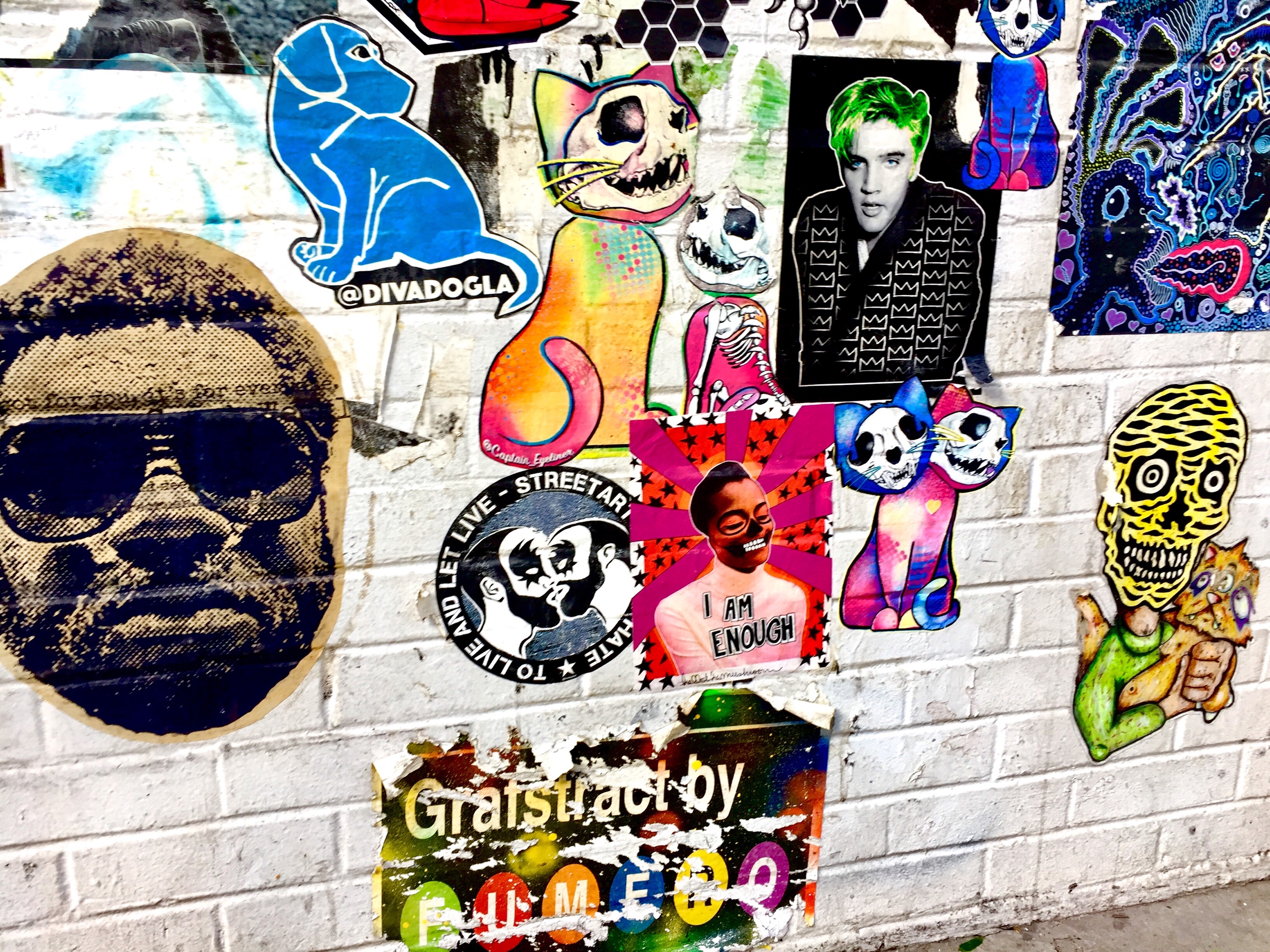
The mecca of street art
New York City is where modern street art began. In the early 1970s, unsigned tags started appearing on subway cars across the five boroughs. Specifically, TAKI 183 — a teenager from Washington Heights — became the first writer to gain citywide recognition, after the New York Times profiled him in 1971. He had tagged every subway line in the system. Others followed immediately. Within two years, the New York subway had become the most concentrated display of unsanctioned public writing in the world. The writers were mostly teenagers from the Bronx, Harlem, and Brooklyn — neighbourhoods that the city had largely stopped investing in. The tags were not decoration. They were proof of existence.
The city treated it as a crime. The Metropolitan Transit Authority spent over 300 million dollars between 1984 and 1989 trying to eliminate graffiti from its trains. Consequently, the writers moved to walls. The South Bronx, Harlem, and Brooklyn became the new canvas. The style evolved rapidly — from simple tags to elaborate wildstyle lettering to full multi-story murals. What started as a signature became a visual language with its own rules, hierarchy, and history. Writers earned reputation through quality, consistency, and reach. Getting up on the most dangerous or most visible spots carried the highest status.
From the Subway to the Gallery
Keith Haring began drawing in the New York subway in 1980 — chalk figures on the black paper used to cover expired advertising panels. His work was illegal and deliberately temporary. Furthermore, Jean-Michel Basquiat started as SAMO© — tagging cryptic phrases across Lower Manhattan before galleries noticed and pulled him inside. Both moved from the street to the international art market within a decade. Their trajectories established the model that defined the next forty years of street art — work that begins outside and ends on a gallery wall, with the street credibility intact and the price tag attached.
The Banksy Effect accelerated this shift in the 2000s. The anonymous British artist turned the urban wall into a platform for political commentary — and made the anonymity itself part of the brand. Banksy’s work proved that street art could generate serious auction prices without the artist ever entering a gallery or revealing their identity. A piece shredded itself at Sotheby’s in 2018 mid-auction and sold for 18.6 million dollars four years later. The market had fully arrived. What the MTA spent three hundred million dollars trying to erase in the 1980s was now selling for eight figures in London auction rooms.
The Bushwick Collective
The Bushwick Collective in Brooklyn is the clearest example of what sanctioned street art looks like at scale. Specifically, it covers over 50 city blocks with murals commissioned from artists across the world. What was a deteriorating industrial neighbourhood in the 1990s is now one of the most visited open-air galleries in the United States. The transformation took less than fifteen years. City governments, real estate developers, and tourism boards have all taken note — and replicated the model in cities from Amsterdam to Berlin.
The economics follow the murals. Property values rise in neighbourhoods where large-scale street art projects take hold. Moreover, the artists who once worked illegally overnight now negotiate contracts, retain intellectual property rights, and collaborate with brands. Modern writers command fees that would have been unimaginable to TAKI 183 in 1971. The street artist as entrepreneur is now a recognised career path in New York City and beyond.
The tension from the original movement has not disappeared. In short, the same walls that once got writers arrested now get them commissioned — and the question of who controls public space, and for whose benefit, remains as contested as it was when the first tag appeared on a Bronx subway car over fifty years ago.
Watch the feature story below.
Produced by Name and Occupation. Images by André Quesnel. Music: The Juggler by David Cutter — davidcuttermusic.com