
Bytown
Ottawa is the capital of Canada and the fourth largest metropolitan area in the country, with a population of approximately 1.48 million. It sits at the confluence of the Ottawa, Rideau, and Gatineau rivers, where the provinces of Ontario and Quebec meet. Bilingual, political, and consistently underestimated by people who have never been there — Ottawa is a city that rewards attention.
The name comes from the Algonquin word adawe, meaning to trade. It was established as a fur trade post, evolved into a timber town, and was incorporated as Bytown in 1826. Queen Victoria of England designated it as the capital of Canada that same year — a decision partly motivated by its distance from the American border, which made it harder to attack. In 2026, Ottawa celebrates its bicentennial. Two hundred years as a capital city. The Gothic Revival towers of Parliament Hill have been watching the country grow from the same hill the entire time.


What to See
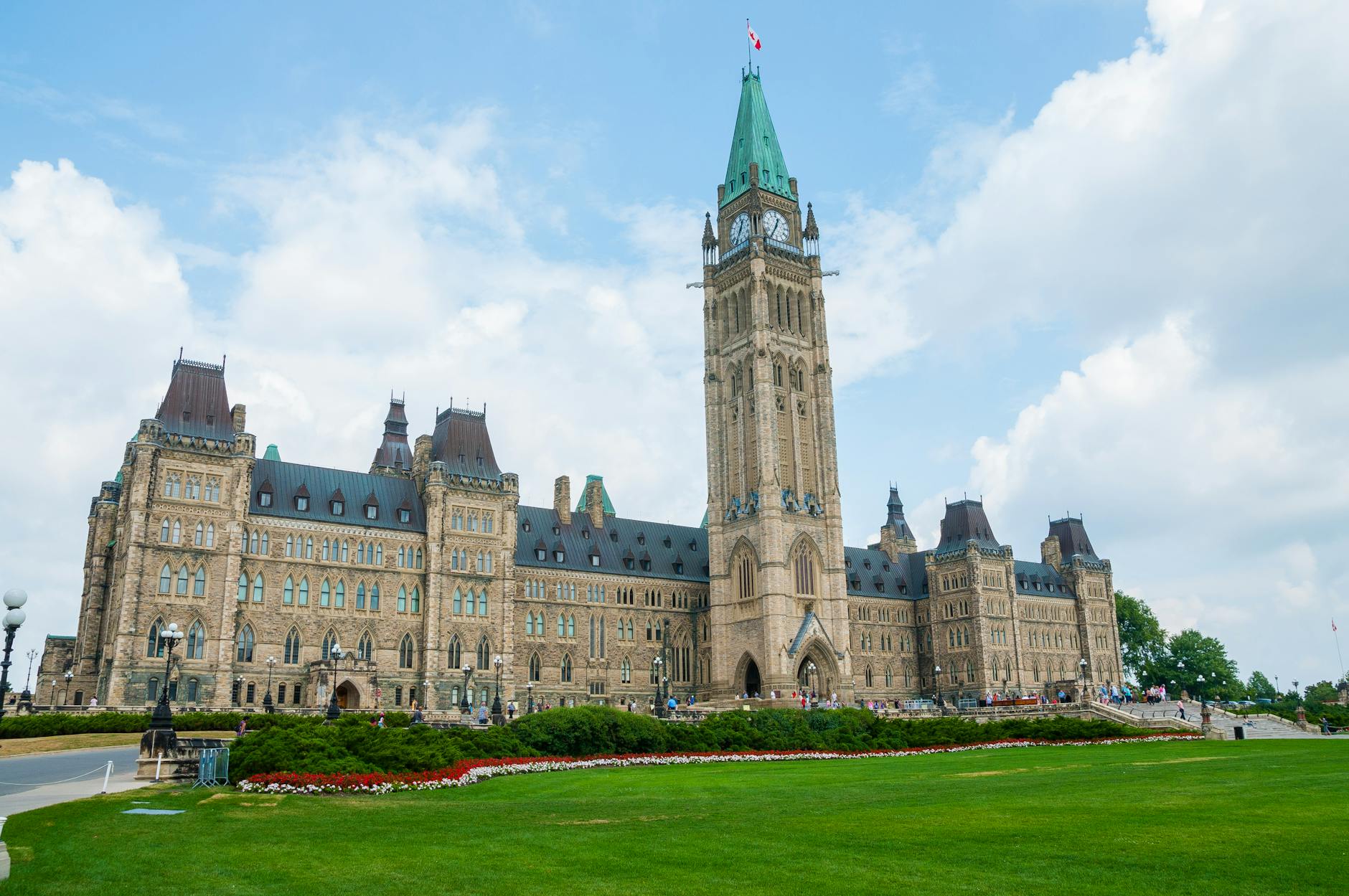
Parliament Hill is the obvious starting point. The Centre Block with its Peace Tower, the Library of Parliament, the eternal flame on the front lawn. It is the physical embodiment of Canadian governance. Free tours run regularly. The Changing of the Guard on the front lawn happens daily in summer.
The Rideau Canal is a UNESCO World Heritage Site. A 202-kilometre waterway connecting Ottawa to Kingston, built between 1826 and 1832. Build as a military supply route. In summer it is a boating and cycling corridor. In winter it becomes the world’s largest naturally frozen skating rink — eight kilometres of maintained ice through the heart of the city. Skating to work on the canal is a specific Ottawa experience that residents treat as entirely normal and visitors find genuinely extraordinary.
The Byward Market is the oldest and largest public market in Canada. It runs year-round in the neighbourhood east of Parliament Hill. In summer the outdoor stalls expand across several blocks. In winter the indoor market holds everything together. It is the best place in the city to eat, drink, and understand what Ottawa actually is beneath the political surface.
The national museums are world class and free — a policy that reflects something genuine about Canadian priorities. The National Gallery holds the most important collection of Canadian art. The Canadian Museum of Nature, the Canadian Museum of History across the river in Gatineau, the Canada Aviation and Space Museum — each one is worth a full afternoon.
Poutine: Ottawa’s Comfort Food
Ottawa’s claim on poutine is serious and contested. Montreal has Schwartz’s. Ottawa has the Poutine Festival — held annually in late April to early May, with over 150 vendors offering somewhere between 150 and 300 varieties. Lebanese-style poutine. Lobster poutine. Creative combinations that stretch the concept until it barely holds together and then deliver something that works anyway. The festival draws competitors from across the country and makes a strong case that Ottawa takes this dish as seriously as anywhere.
The origin story is specific. In 1967, in Drummondville, Quebec, a customer at a chip stand asked for cheese curds on his fries. Gravy was added. The combination held. Poutine spread from there across Quebec and eventually across the country. The key ingredient is the cheese curd — fresh, squeaky, made before the curds solidify into blocks. That squeak is not a quirk. It is the indicator of freshness that makes the dish work. Ottawa’s dairy supply chain keeps the curds fresh. The results show.
BeaverTails are the other essential Ottawa food experience. The flat fried dough pastry — shaped like a beaver’s tail, covered in toppings from cinnamon sugar to Nutella — originated at Byward Market in 1978. Grant and Pam Hooker started selling them from a stall and built a business that eventually expanded across the country. The original Byward Market location is still the best place to eat one — warm, slightly too messy, ideally consumed outside in cold weather near the canal.
Hotels.com: Save up to 25% on mobile exclusive offers!
Street Art
House of PainT Urban Art Festival
Canada’s first legally recognized graffiti wall lives under a bridge at Carleton University. What started as an unsanctioned gathering spot for writers and b-boys became official when artists lobbied the city for legal status. They got it. That wall became the foundation for House of PainT—one of Canada‘s largest urban art festivals.
The festival runs annually, curated by practitioners instead of organizers. Artists come to paint, not perform painting for audiences. The programming stays true to the four pillars of hip-hop culture: DJs, MCs, breakdancing, and graffiti. No corporate sponsors. No mainstream dilution. Just city funding meeting underground culture in a combination that’s rarer than it sounds.
Ottawa’s street art scene punches above its weight. Writers here paint in Toronto, Montreal, New York—then bring that back. The House of PainT festival is where they come home. The bridge wall still gets painted. The culture that started underground stayed underground. It just happens to have legal protection now. Full Article
Music Scene
Ottawa has produced an unlikely list of significant artists. Alanis Morissette grew up here and recorded her early work in the city before relocating to Toronto and then Los Angeles. Paul Anka wrote and recorded his first hits as a teenager in Ottawa in the late 1950s. Dan Aykroyd is from Ottawa. Tom Green is from Ottawa. The Ottawa Valley folk tradition — rooted in French, Scottish, and Irish communities — runs through the region’s music culture in ways that are still visible in the live scene today.
Lafayette on York Street is the oldest live entertainment bar in the city. Steve’s Music Store on Rideau Street has been the equipment supplier for Ottawa musicians for decades. The Bytown Theatre and the NAC — the National Arts Centre — cover the more formal end of the spectrum. In between, the neighbourhood bars and the Byward Market area sustain a live music culture that punches well above the city’s size.
Music Story
Secret Jams: The Bender Recap!
The Bender is a secret music festival that has been running in the Ottawa Valley for 42 years. It operates at an undisclosed location. You need a membership to attend. The perks include a T-shirt and three days of music from artists who exist entirely outside the mainstream. It is the kind of event that the NAO Podcast was built to cover — hidden, genuine, worth finding.
The festival introduced NAO to Birdie Whyte — a singer whose vinyl Here’s Where I Find Myself is worth tracking down. She plays live every Sunday evening at Irene’s Pub on Frank Street in Ottawa. Furthermore, CA and the Sunny Show — banjo, harmonica, three days of music that demonstrated exactly why The Bender has sustained itself for four decades without any publicity.
Music Video
Chris Carkner – Together
NAO has covered Ottawa extensively. Dessert First — Julia Gindra’s boutique bakery at Byward Market. Kristina Allen — the fitness instructor who rebuilt her mobility after paralysis. Marc Cinanni — the Catalan retreat founder who started in Ottawa. David Gogo — the Canadian blues guitarist. Nathan Bishop MacDonald — the musician and creative. Chris Carkner — chef, musician, podcast co-host.
In addition, the Anonymous Reality Documentary — Erik Nieminen’s decade in the art world — passes through Ottawa as one of its chapters. The House of PainT festival, one of Canada’s largest hip hop and street art events, is based here.
Ottawa is not the city people expect. It is better than that.
Related